
How patient-specific implant manufacturing is moving closer to the point of need
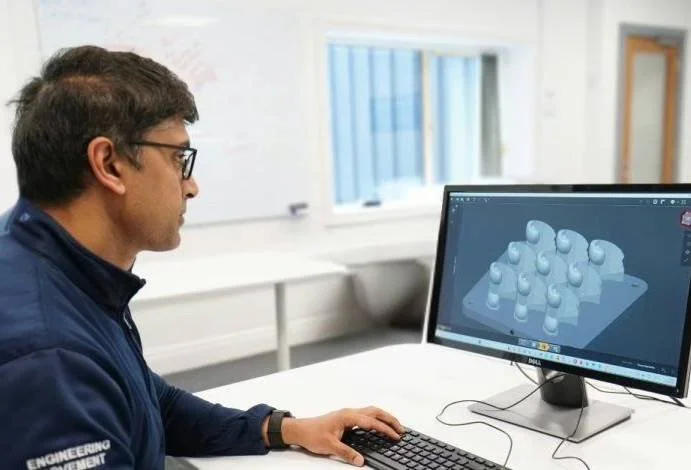
Croom Medical’s in-house additive manufacturing capability shows how Irish MedTech companies are supporting faster, more integrated production of patient-specific implants.
Patient-specific medical devices show how advanced manufacturing can respond to one of the most important shifts in healthcare: the move toward more personalised treatment.
Croom Medical, based in Limerick, has brought patient-specific implant manufacturing fully in-house for orthopaedic original equipment manufacturers. The company says this move can reduce the turnaround for a complete, inspected implant from weeks or months to days.
That matters because speed can be clinically important in patient-specific implant manufacturing. These products are often designed for complex cases where standard implants may not be suitable. When production depends on several external suppliers, each handoff can add time, cost and complexity. Bringing more of the process into one site can help reduce delays and give greater control over quality, documentation and delivery.
Croom’s model is build-to-print. The original equipment manufacturer retains responsibility for design, intellectual property and regulatory filing, while Croom manufactures to the required specification and supplies the documentation needed to support that process. This is a practical example of how specialist manufacturing partners can support medical device companies without taking ownership of the product concept.
The types of implants involved are technically demanding. Croom reports that the capability is suited to complex, low-volume devices such as ankle implants, acetabular cups, interbody cages, revision cones, post-traumatic reconstruction devices and craniomaxillofacial implants. These are not simple products. They require precision, material knowledge, quality control and the ability to manage variation.
Additive manufacturing is particularly relevant in this context because it can support complex geometries, porous structures and patient-specific designs that may be difficult or inefficient to produce through conventional manufacturing alone. In orthopaedics, this can be valuable where implant shape, surface structure and biological integration all influence performance.
The materials involved are also significant. Croom is working with titanium, cobalt chrome and tantalum, all of which have established relevance in orthopaedic and implant applications. The company also reports that each material runs on its own machine to limit cross-contamination, reflecting the importance of process discipline in regulated medical manufacturing.
The story is not just about 3D printing. It is about the wider production system around additive manufacturing. A patient-specific implant needs more than a printed part. It requires design control, validated processes, inspection, finishing, documentation and regulatory support. The value comes from integrating these steps into a production pathway that can respond quickly and reliably.
Croom’s existing manufacturing base gives the announcement further weight. The company reports more than 40 years in orthopaedic manufacturing, annual output above 250,000 knee systems, ISO 13485:2016 certification, FDA registration and additive manufacturing experience dating back to around 2010. It also reports more than 60,000 additive-manufactured implants produced to date.
This is important because patient-specific manufacturing requires both flexibility and credibility. A company must be able to produce customised or low-volume devices, but it must also do so within a controlled manufacturing environment. The challenge is to combine responsiveness with the quality expectations of medical device production.
Croom is also expanding its Limerick campus through its Advanced Center of Orthopedic Technologies, adding further finishing and production capability. That points to a broader theme in MedTech manufacturing: companies are investing not only in individual technologies, but in integrated capability.
For Irish MedTech, this is a strong signal. Ireland already has a significant medical device and life sciences manufacturing base. Stories like this show how that base is evolving toward more specialist, advanced and personalised production models. The opportunity is not only to manufacture at scale, but to develop capabilities that support complex, high-value medical products.
For SMEs and innovation-led companies, the lesson is that additive manufacturing should not be viewed as a standalone technology. Its real value often depends on how it is connected to design, materials, quality systems, finishing, inspection and regulatory documentation. Without those surrounding capabilities, a printed implant remains only one part of the pathway.
Croom Medical’s move to bring patient-specific implant manufacturing in-house highlights the growing importance of speed, control and integration in medical device production. It shows how advanced manufacturing can support more personalised care while also strengthening the production capability needed to bring complex devices to market.
As patient-specific devices become more important across orthopaedics and other areas of medicine, manufacturing partners with integrated additive capability are likely to play a bigger role. The ability to move from specification to inspected implant quickly and reliably could become a valuable advantage in a market where clinical need, customisation and quality all matter.
Original article