
Micro 3D Printing Moves MedTech Components Towards Production
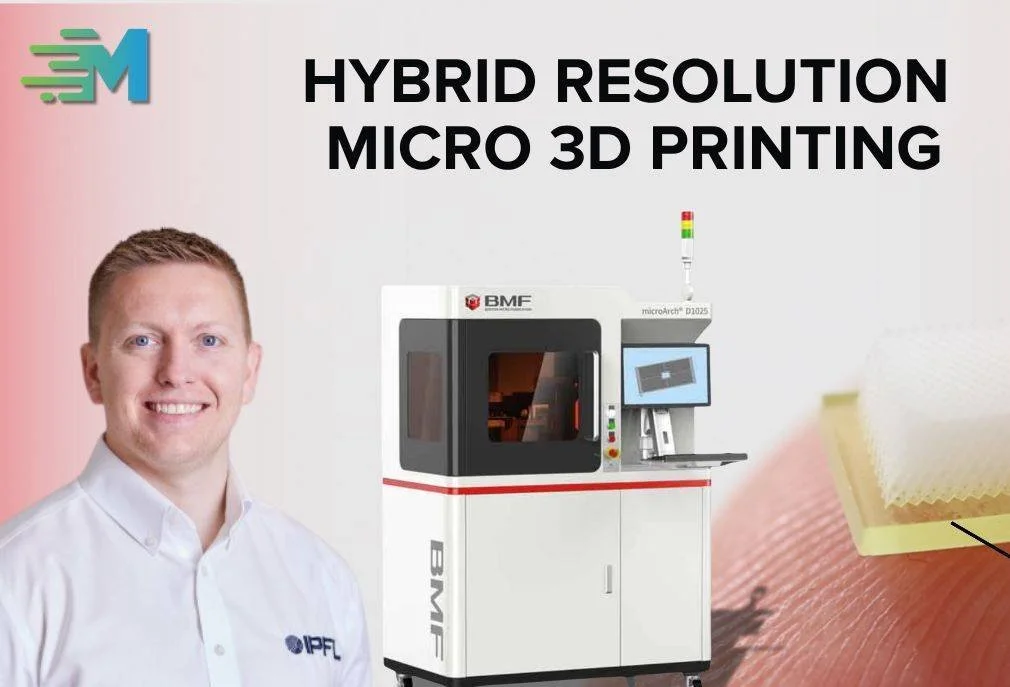
High-resolution additive manufacturing is opening new routes for microneedles, microfluidics and complex medical-device components, but production readiness still depends on materials, repeatability and validation.
Micro-scale 3D printing is moving beyond conventional prototyping and into applications where very small features, intricate internal geometries and short production runs can create practical value for MedTech developers.
A recent Med-Tech Insights interview with Adam Bloomfield of UK precision manufacturer IPFL highlights the use of projection micro-stereolithography to produce features at resolutions down to 10 microns and, on selected systems, 2 microns. Potential applications include microneedle arrays, microfluidic components and other complex parts used in medical devices and life-science products.
The technology offers designers greater freedom to test geometries that may be difficult or costly to produce through conventional tooling. It can also support rapid iteration and small-batch manufacture during product development. For SMEs, this may shorten the route between an initial design and a functional component that can be assessed in a realistic application.
However, finer resolution alone does not make a process production-ready. Medical-device teams still need to consider material suitability, dimensional consistency, surface finish, cleaning, biocompatibility, inspection and process validation. Where components form fluid pathways or interact with tissue, these requirements become particularly important.
The wider signal is that additive manufacturing is becoming more specialised. Its value increasingly lies in solving tightly defined manufacturing problems rather than replacing established processes across an entire product. For MedTech SMEs, the opportunity is strongest where micro-scale features, customisation or low-volume production create a clear technical and commercial advantage.
Original article