
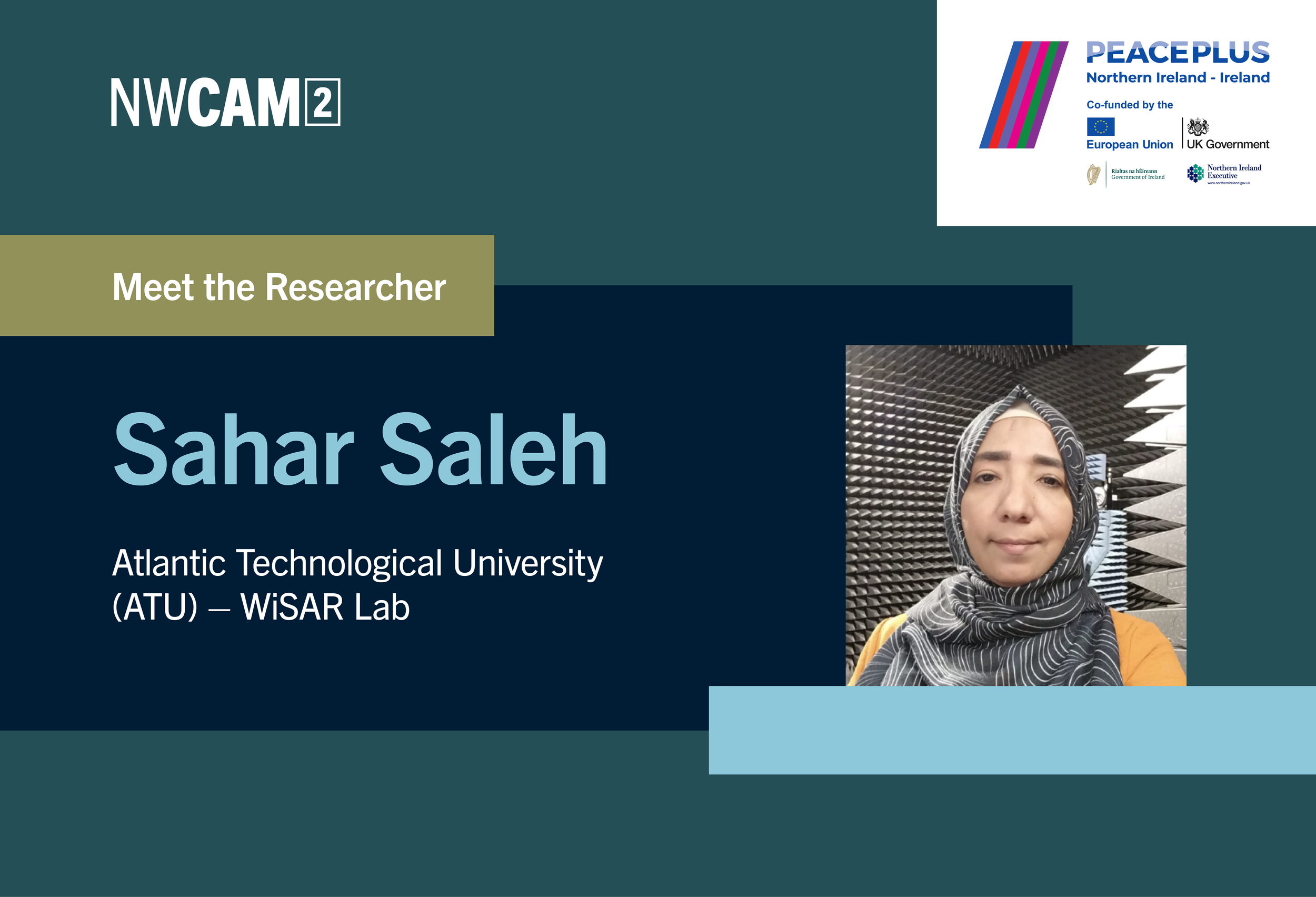
From wearable healthcare devices to next-generation vehicle communications, research at Atlantic Technological University (ATU) is exploring how advanced antenna technologies can support more reliable and efficient wireless connectivity.
In the first of our Meet the Researcher series, we caught up with Sahar Saleh, Senior Research Fellow in Advanced Manufacturing – Wireless Solutions at ATU’s WiSAR Lab, to learn more about her research, its potential real-world applications and how NWCAM2 is supporting the development of wireless technologies through advanced manufacturing.
1. Can you tell us a little about yourself and the research you're undertaking through NWCAM2?
I am a Senior Research Fellow in Advanced Manufacturing – Wireless Solutions at the WiSAR Lab, Atlantic Technological University, working through the NWCAM2 programme. My research focuses on the design, fabrication and experimental evaluation of antenna and RF technologies for applications including wearable and implantable healthcare devices, vehicular communications, wireless sensing, advanced manufacturing and high-frequency space and satellite communication systems.
My role combines applied research, postgraduate supervision and hands-on laboratory work. I supervise and co-supervise postgraduate researchers, contribute to collaborative research projects, and support antenna fabrication and experimental characterisation using a vector network analyser, an anechoic chamber and LPKF PCB prototyping facilities. I am also supervising an NWCAM2-funded PhD researcher investigating antenna design for additive manufacturing, initially focusing on medical-device-related applications and considering antenna performance, material selection and manufacturing constraints together during the design process.
Through NWCAM2, I am exploring how wireless technologies can contribute more directly to advanced manufacturing. This includes developing compact wireless components, investigating new fabrication methods and considering how manufacturing processes can use materials more efficiently and potentially reduce waste.
2. You've recently published research on antenna technologies for wearable healthcare devices and vehicular communications. Can you explain what these projects involve and what you've discovered?
The wearable-healthcare research involved the development of a compact four-port Hilbert-slot MIMO antenna for millimetre-wave medical telemetry and body-centric communications. The fabricated antenna achieved a measured operating range of 24.71–63.81 GHz, while the transmission coefficients between its ports remained mostly below −20 dB. The design was also evaluated under bending and body-loading conditions using a full-body CST model. The results showed that the antenna could maintain wideband and diversity performance under the representative body-worn conditions considered in the study.
The vehicular research involved developing a compact ultra-wideband Vivaldi antenna using a radial-to-radial feeding transition and an impedance-matching transformer. The fabricated antenna achieved measured impedance matching from 2.58 to 22.34 GHz, a peak measured realised gain of 7.45 dBi and a footprint reduction of 16.67% compared with the reference design.
We also examined the Vivaldi antenna in stationary rooftop-mounted vehicle models to investigate directional wireless links between vehicles. This was a controlled simulation study and not a full dynamic road test. However, it provided useful information about the effects of vehicle integration, antenna orientation and separation distance on the communication link.
A common outcome from both projects was the importance of considering the antenna’s intended operating environment during the design stage. A compact antenna may perform well in free space, but its behaviour can change when it is positioned near the human body or integrated with a vehicle. Therefore, realistic modelling, fabrication and measurement are all important parts of the development process.
3. What potential real-world applications could come from this research, particularly for businesses working in healthcare, manufacturing or connected technologies?
The wearable antenna could support future communication between body-worn sensors and monitoring devices. Potential applications include short-range links between sensing nodes positioned at different locations on the body, such as the wrist, shoulder or knee. The research does not present a complete clinical monitoring system, but it demonstrates the antenna and link-level performance needed to support the future development of such platforms.
The Vivaldi antenna could contribute to short-range directional vehicle-to-vehicle links, broadband automotive sensing and localisation research. As the present vehicle investigation used stationary simulation models, further experimental and dynamic testing would be needed before considering practical road deployment.
More broadly, RF and wireless technologies play an important role in many real-world applications because reliable communication is increasingly required in healthcare, manufacturing, transportation, sensing and connected devices. My interest is in developing antennas and wireless components that are not only technically effective but also practical to manufacture, integrate and test.
Additive manufacturing and printed electronics could provide another route for producing these components. For example, flexible antennas, printed sensors and RF structures may be fabricated directly on flexible or non-standard substrates. This could allow faster design iterations and more controlled material deposition. However, any reduction in material waste must be assessed through the actual fabrication process rather than assumed from the manufacturing method alone.
4. How has being part of NWCAM2 supported your research and helped you progress your work?
My position as a Senior Research Fellow in Advanced Manufacturing – Wireless Solutions through NWCAM2 has opened a practical new direction for my research. It enables me to apply my background in antennas, RF engineering and wireless communications to advanced manufacturing, particularly through printed electronics, additive manufacturing and more efficient RF prototyping.
I began exploring this direction through my accepted paper on a miniaturised PDMS-based UHF RFID antenna for shallow subcutaneous implantation, designed with potential for future RF additive manufacturing. The paper will be presented at APACE 2026 in Melaka, Malaysia, from 8 to 10 December 2026. This work led me to consider antenna performance, material selection and manufacturing constraints together from the start of the design process. I am also preparing a review paper on additive-manufacturing methods, materials and challenges for antennas and RF components.
This interest now extends to my high-frequency and space-communication research. I would like to investigate whether the antenna presented at the ESA workshop could be adapted for 3D printing or another additive-manufacturing process. At these frequencies, fabrication resolution, surface roughness, dimensional accuracy, conductive materials and electromagnetic losses would require careful evaluation. This could also help assess whether additive processes can reduce fabrication stages and material waste compared with conventional methods.
NWCAM2 connects electromagnetic modelling with fabrication, measurement, postgraduate supervision, proposal development and industry engagement. Proposal writing is also part of my role, particularly for research ideas that link wireless technologies with advanced manufacturing and practical applications.
At the WiSAR Lab, the vector network analyser, anechoic chamber and LPKF PCB prototyping system allow us to fabricate and characterise antenna and RF prototypes and investigate practical effects such as manufacturing tolerances, connector effects and differences between simulated and measured material properties.
The programme is also supporting the expansion of our printed-electronics capability through the planned Voltera NOVA platform. It would complement our existing facilities by supporting rapid, small-batch fabrication of printed antennas, sensors, RF structures, interconnects and flexible circuits, followed by VNA characterisation and anechoic-chamber evaluation. This would shorten the design–fabricate–test cycle, reduce dependence on external fabrication and support more material-efficient RF prototyping.
NWCAM2 also supports my postgraduate supervision. I am the main supervisor of an NWCAM2-funded PhD researcher investigating antenna design for additive manufacturing, initially for medical-device-related applications, and I co-supervise three other PhD researchers within WiSAR. These roles involve supporting antenna and RF research across simulation, fabrication, measurement and research development.
I am grateful to NWCAM2 for the research framework, equipment budget and opportunities to develop this area. Together, these capabilities will strengthen our environment for conventional, flexible and printed RF research, postgraduate training, collaborative proposals and engagement with academic and industry partners.
5. You've also had papers accepted for international conferences, including an ESA workshop. What's next for your research, and what are you most excited about developing further?
One current direction is a compact four-port dual-band antenna based on directly excited high-impedance-surface unit cells for high-frequency communication applications. The simulated design covers 89.65–177.4 GHz and 200.72–239.86 GHz, with inter-port isolation better than 20 dB and a peak realised gain of approximately 15 dBi. As the work is currently simulation-based, fabrication and experimental validation are the next important steps.
I am particularly interested in adapting this type of antenna to realistic additive-manufacturing constraints. The work will require careful evaluation of fabrication resolution, dimensional tolerance, surface roughness, conductor properties and material losses before 3D printing can be considered a validated solution at these frequencies.
This direction complements the NWCAM2-funded PhD project I supervise on antenna design for additive manufacturing. It will allow us to investigate technical performance, manufacturability, material use and experimental validation together, while assessing potential sustainability benefits rather than assuming them.
The ATU team is working with Catalyst to identify a suitable industry partner for the PhD project, and I appreciate their prompt and practical support in progressing potential collaborations.
My longer-term aim is to integrate antenna design, advanced manufacturing and experimental validation more closely, using our simulation, fabrication and measurement capabilities to develop conventional, flexible and printed RF components.
About NWCAM2
NWCAM2 brings together academic and industry partners to advance research, innovation and the adoption of advanced manufacturing technologies across Northern Ireland and the border counties.
NWCAM2 is supported by PEACEPLUS, a programme managed by the Special EU Programmes Body (SEUPB).